
Chapter 6 - Open Economy Macroeconomics
-
Open economies interact with the global market through trade, finance, and migration. Their primary linkages include:
a) Output Market
-
Involves the movement of goods and services across borders.
-
International trade expands consumer and producer choices by providing access to both domestic and foreign goods and services.
-
Considered the most significant linkage between open economies.
b) Labour Market
-
Firms and workers can relocate or seek employment across borders.
-
Movement is subject to immigration policies and national restrictions.
-
Increases mobility of skilled and unskilled labour.
c) Financial Market
-
Allows access to foreign financial assets.
-
Investors can diversify their portfolios by investing in financial instruments issued in other countries.
-
Facilitates cross-border financial flows.
-
Movement of goods and services is often considered the primary linkage between open economies. An open economy is characterized by its engagement in international trade and financial transactions.
-
Foreign trade influence Indian aggregate demand in two ways: 1) Imports result in a leakage from the domestic economy, reducing aggregate demand, and 2) Exports contribute to the circular flow, increasing aggregate demand for domestic goods.
-
When goods and services are traded internationally, money is used to settle the transactions.
-
There is no single international currency that is used by all countries. Governments often pegged their national currencies to a stable asset, such as gold or another country's currency. This means that the issuing authority cannot control the value of the asset to which the currency is pegged.
-
For instance, if a currency is pegged to gold, its value would be determined by the price of gold in the international market, rather than by the issuing government.
-
Similarly, if a currency is pegged to another country's currency, its value would fluctuate based on changes in the value of that currency.
-
-
Credibility of a fixed exchange rate depends on its convertibility and stability. The international monetary system aims to maintain this credibility and stability in global transactions.
-
When an Indian purchases an American product, they need to exchange Indian rupees for US dollars. The value of the dollar in terms of rupees, known as the exchange rate, determines the cost of the product in rupees.
THE BALANCE OF PAYMENTS
-
The balance of payments (BoP) summarizes the financial transactions between a country and the rest of the world over a specific period, typically a year.
-
It consists of two main accounts: the current account and the capital account.
Current Account
-
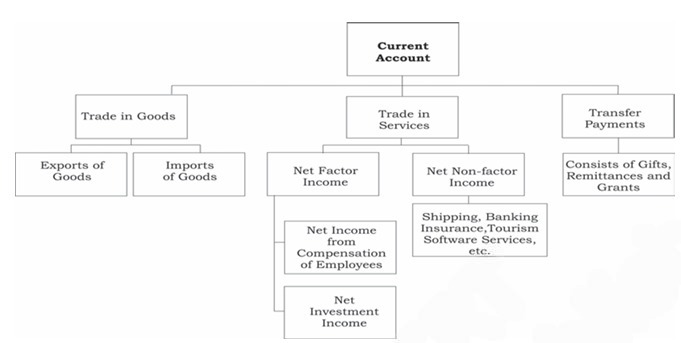
The Current Account is a record of a country's trade in goods and services, as well as transfer payments.
-
Transfer payments are one-way payments from one entity to another, typically from governments or private individuals, without any goods or services being exchanged in return. These include gifts, remittances, and grants.
-
When a country imports goods from another country, it is essentially transferring money to that country in exchange for those goods. This transfer of money can have a negative impact on the domestic economy.
-
When a country exports goods to another country, it is essentially earning money from that country in exchange for those goods. This inflow of money can have a positive impact on the domestic economy.
Balance on Current Account
-
A current account balance occurs when the total income from exports, services, and transfers equals the total expenditure on imports, services, and other international transactions.
-
For example, if Country X exports $100 billion worth of goods, receives $50 billion in income from abroad, and receives $20 billion in transfers, while spending $120 billion on imports, paying $40 billion in income to foreigners, and sending $10 billion in transfers abroad, it achieves a current account balance of zero.
|
Current Account Surplus
|
Balanced Current Account
|
Current Account Deficit
|
|---|---|---|
|
Receipts > Payments
|
Receipts = Payments
|
Receipts < Payments
|
-
Balance on Current Account has two components:
a) Balance of Trade or Trade Balance: The balance of trade (BOT) evaluates a country's goods trade with others, where exports are credits and imports are debits.
-
A positive BOT indicates higher exports, a negative BOT shows more imports, and a balanced BOT means equal exports and imports.
b) Balance on Invisibles: “Invisibles” refer to intangible items exchanged with other countries. These include services, transfers, and income flows. Invisibles have two components:
-
Factor Income: Earnings or payments related to factors of production (land, labour, capital). Examples: Income from overseas employment, Interest payments, Profits from foreign investments.
-
Non-Factor Income: Earnings from services not directly linked to factors of production. Examples: Shipping services, Banking services, Tourism, Software services
-
Net invisibles represent the gap between a nation's exports and imports of intangible goods, such as services, transfers, and income flows.
|
Net Invisibles = Invisible Exports – Invisible Imports
|
Capital Account
-
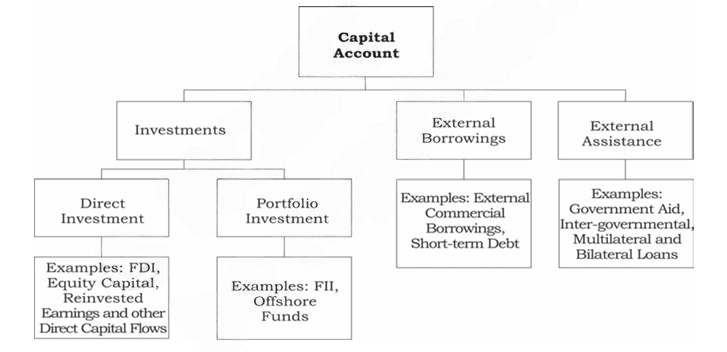
Capital accounts record the inflow and outflow of assets, representing the financial transactions between a country and the rest of the world.
-
Assets include various forms of wealth, such as money, stocks, bonds, and government debt.
-
The purchase of assets, which signifies an outflow of capital, is considered a debit item in the capital account.
-
Capital account transactions record the purchase and sale of assets across borders. Outflows are debit items, while inflows are credit items. They include FDI, FII, external borrowings, and foreign assistance.
|
Balance on Capital Account
-
A balanced capital account occurs when the inflow and outflow of capital are equal, indicating a stable and self-reliant economy.
-
A deficit indicates a lack of domestic investment, while a surplus can raise currency value and hinder exports. Policymakers aim to maintain a balanced capital account through various tools to stabilize the economy.
-
Capital account surplus arises when capital inflows are greater than capital outflows and deficit arises when capital inflows are lesser than the capital outflows.
Balance of Payments Surplus and Deficit
-
Achieving balance in current and capital accounts is crucial for a country's economic stability and sustainable growth, as it reflects spending, earnings, and foreign capital inflows. Achieving this balance requires increasing exports to match imports and effectively utilizing foreign capital for productive investments.
| Current account + Capital account = 0 |
-
In the above situation country is said to be in balanced payments equilibrium and the current account deficit is financed by international lending without any reserve movement.
-
To balance its balance of payments the country could use its reserves of foreign exchange and when there is deficit the reserve banks sell foreign exchange and this is called official reserve sale.
-
The overall balance of payments deficit or surplus is the net result of all transactions recorded on the current and capital accounts. It represents the net change in the country's official reserves of foreign exchange.
-
A deficit indicates that the country has used up some of its reserves to finance its international transactions, while a surplus indicates that the country has accumulated additional reserves.
-
Fixed exchange rates demand frequent central bank intervention, increasing official reserve transactions. Floating rates allow natural currency fluctuations, reducing the need for intervention and lower official reserve transactions.
Autonomous and Accommodating Transactions
-
Autonomous transactions in the balance of payments (BOP) refer to international economic transactions that are driven by profit motives or other factors independent of the overall balance of payments situation. These transactions are typically recorded above the line in the BOP statement.
-
Accommodating transactions (termed ‘below the line’ items) are determined by the gap in the balance of payments. They arise as a result of the imbalance between autonomous receipts and autonomous payments, and they serve to offset the difference. In other words, they are determined by the net consequences of the autonomous transactions.
-
Official reserve transactions are considered accommodating items in the balance of payments (BOP) because they are made to bridge the gap between autonomous receipts and autonomous payments. In other words, they are the transactions that are undertaken to offset any imbalance in the BOP.
Errors and Omissions
-
Errors and omissions are a third element of the balance of payments (BOP), alongside the current and capital accounts. They represent the difference between the recorded credits and debits in the BOP statement.

-
The balance of payments accounts are now divided into three accounts: current account, financial account, and capital account.
-
Almost all transactions arising from trade in financial assets, such as bonds and equity shares, are now placed in the financial account.
THE FOREIGN EXCHANGE MARKET
-
Exchange rates have a significant impact on trade, investment, and tourism. The major participants in the forex market are commercial banks, brokers, authorized dealers, and monetary authorities.
-
The foreign exchange market is a global and decentralized network, allowing participants to trade from anywhere in the world. Trading centres are interconnected, and participants can access liquidity and execute transactions across different regions.?
Foreign Exchange Rate
-
The foreign exchange rate, or forex rate, is the value of one currency in terms of another. It allows for the conversion of currencies and enables comparisons of international prices. For instance, if one-dollar costs 50 rupees, the exchange rate is 50 rupees per dollar.?
Demand for Foreign Exchange
-
A depreciation in the domestic currency increases the cost (in terms of rupees) of purchasing foreign goods, reducing the demand for imports and, consequently, the demand for foreign exchange.
|
For example, let's consider India's trade with the United States.
|
Supply of Foreign Exchange
-
Foreign currency flows into a country when foreigners purchase its goods and services, send gifts or make transfers, or buy assets like stocks or real estate.
-
These inflows can appreciate the domestic currency, increase investment, and improve the balance of payments.
-
A depreciation of the Indian rupee makes exports cheaper for foreigners, boosting India's exports. However, the actual impact depends on factors like demand elasticity and substitute availability.
|
For example, suppose the Indian rupee depreciates against the US dollar. Previously, 1 US dollar was equal to 70 Indian rupees, but now it's equal to 75 Indian rupees due to depreciation.
|
Determination of the Exchange Rate
-
Countries determine their currency's exchange rate through flexible, fixed, or managed floating exchange rate systems.
-
Flexible systems let market forces determine the rate, while fixed systems peg it to a fixed level. Managed systems allow some fluctuation within a predetermined band. The choice of system depends on factors like economic situation and trade patterns.?
Flexible Exchange Rate
-
A flexible exchange rate is determined by supply and demand in the foreign exchange market. This means that the price of one currency in terms of another is constantly changing.
-
Flexible exchange rates are seen as beneficial because they allow the exchange rate to adjust automatically to changes in the economy. However, they can also be more volatile.
-
In a completely flexible exchange rate system, central banks let market forces, not government intervention, determine the value of currencies. This system offers flexibility and adaptability, but also carries the risk of volatility.
-
An increase in the demand for foreign goods and services leads to an appreciation of the exchange rate and a depreciation of the domestic currency. This can have implications for both exports and imports, as well as the overall cost of living.
|
For example,
|
-
An appreciation of the domestic currency (rupees) in terms of foreign currency (dollars) means that the value of the rupee has increased relative to the dollar. In other words, you need to pay fewer rupees to exchange for one dollar. This can have several implications for trade and the economy.?
Speculation
- The anticipation of currency appreciation can significantly impact exchange rates.
- This occurrence is termed as the self-fulfilling prophecy, where anticipations regarding future exchange rates shape current market demand and supply dynamics.
|
Interest Rates and the Exchange Rate
-
Interest rate differentials are one of the important factors that can affect exchange rates in the short run.
-
When there is a difference in interest rates between two countries, investors will be attracted to the country with the higher interest rate.
- When interest rates in country B rise, investors will find it more attractive to invest in country B, and will therefore demand more of country B's currency.
- At the same time, investors in country A will find it less attractive to invest in country A, and will therefore demand less of country A's currency.
-
This can lead to an increase in demand for the currency of the country with the higher interest rate, and a decrease in demand for the currency of the country with the lower interest rate.
-
This can, in turn, lead to a depreciation of the currency of the country with the lower interest rate, and an appreciation of the currency of the country with the higher interest rate.
?
Latest Studies
-

Chapter 5 - Government Budget and the Economy
-

Chapter 4 - Determination of Income and Employment
-

Chapter 3 - Money and Banking
-

Chapter 2 - National Income Accounting
-

Chapter 1 - Introduction
